What the Next Stage Requires
“Growing a farm isn’t just about adding more. Eventually, you have to build the systems capable of carrying what you’ve already built.”
Farm Snapshot
Journal Entry: 007
Date: September 6, 2026
Season: Late Summer
This Week’s Focus: Learning what the next stage of DaleWood requires—from livestock and water to processing, customers, community, equipment, and the ground beneath our feet.
I’m writing this one after coming in from feeding piglets this morning.
We finally got some rain yesterday, and after the heat we dealt with earlier this week, everything outside feels different.
Cooler. Wet. Quiet.
This morning was feed, nursery pens, bedding, wood chips, and moving a few piglets around.
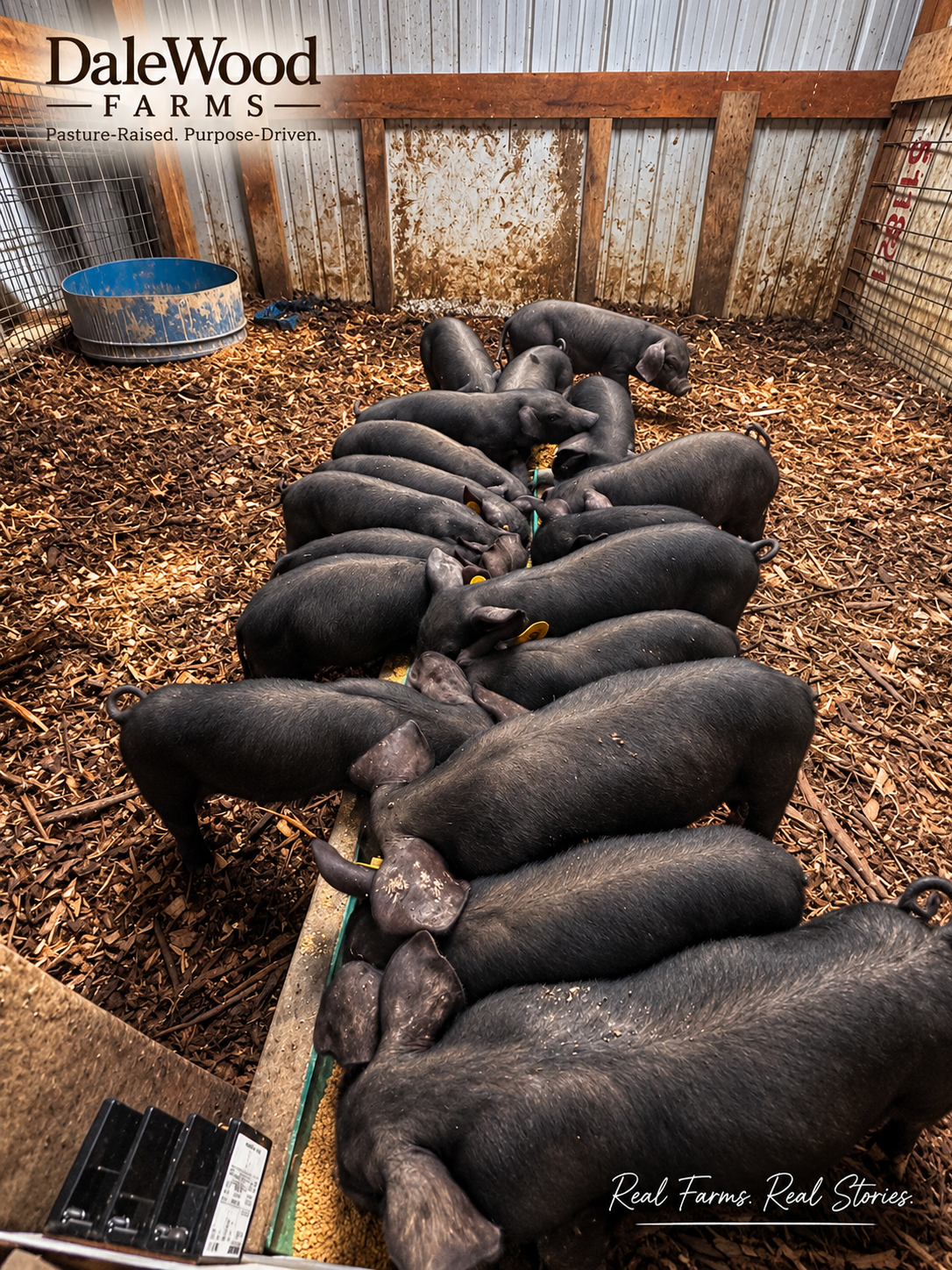
Then I stood there for a minute watching them lined up at the trough eating.

There are several stages of pigs represented at DaleWood right now.
We’ve got piglets that have already been weaned and moved into nursery groups. We’ve got growers. We’ve got pigs in grow-out. We’ve got breeding animals. We’ve got healthy piglets available and growing strong.
And then we’ve still got roughly a dozen from the later litters nursing.
I’m not in a hurry to force those younger ones off their mothers.
They’re eating feed. They’re growing. They’re moving around with everybody else. So I’ve been watching what happens if I give them a little more room to make that transition naturally.
Sometimes farming is doing the work.
Sometimes farming is knowing when to leave something alone long enough to learn from it.
That’s where this week’s walk begins.
Farm Walk
Stop #1 — The Other Side of Weather
We’ve spent quite a bit of time learning what cold weather can do to pigs.
This week taught the opposite lesson.
Heat.
For several days this week, temperatures around this part of Indiana were in the 90s. By the middle of the week, we were dealing with temperatures around 94–95 degrees, with the heat index pushing around 100.
And when you’ve got pigs at several stages of development, that changes the work.
Baby pigs. Nursing litters. Weaners. Growers. Grow-outs. Breeding animals.
They don’t all respond exactly the same way, but one thing becomes pretty universal when it gets that hot:
You pay attention to water.
I kept the nursery opened up for airflow where I could. We rotated animals where they could use pasture and shade. I watched the nursing animals.
And I spent a whole lot of time making sure water kept moving.
That’s also where this week exposed one of DaleWood’s infrastructure limitations.
When I say we’re moving water more than 150 feet from the house toward the livestock areas, this is what I’m talking about.

Right now, that distance is handled with hose.
It works.
But every additional animal, pen, and hot day asks a little more from a system that was never originally built to water a growing livestock operation.
Friday, between moving bedding and material, managing pigs, preparing animals to leave, and keeping everybody watered, I sweated through three complete sets of clothes.
Three.
At some point I wasn’t changing clothes anymore.
I was just resetting the timer.
But underneath all that sweat was something worth documenting.
The water problem introduced itself.
I don’t know exactly what the permanent solution looks like yet. I’m not going to pretend we’ve already engineered something we haven’t.
But if DaleWood continues growing, the livestock water infrastructure is going to have to grow with it.
That’s why I wanted this picture in the Journal.
One day, if there’s permanent water running where we need it, we’ll have the photograph showing what came before it.
Stop #2 — Pigs Are Starting to Move Through the System
Friday was also a pretty significant livestock day.
Ten gilts left DaleWood, along with a boar we’d acquired for the client.
Eleven pigs loaded up and moved on.
That matters.
Not simply because pigs were sold.
It matters because we’re beginning to see flow.
For a long time, building the livestock side of DaleWood meant adding.
Add a sow. Add another pen. Add another litter. Build another area. Solve another problem.
Now animals are beginning to move through the system.
They’re born here.
They nurse.
They grow.
They move through nursery groups.
Some enter grow-out.
Some may be retained.
Some leave for other farms.
Some become food.
And then the process starts again.
Some of the best evidence of that system is standing right outside the barn.

Those aren’t little nursery pigs anymore.
These are some of our February animals now moving through grow-out. The difference between the piglets at the trough this morning and these pigs is several months of feed, water, pasture, weather, and management.
That’s the part of raising livestock that’s easy to miss when you only see one photograph at a time.
And that’s part of why I keep writing these Journals.
The five purebred Meishan gilts we recently brought onto the farm are settling in extremely well too. They’re becoming part of the longer-term breeding picture while other animals are moving out.
And we’re starting to see more of what happens after DaleWood pigs leave.

Those are the two pigs that left for Ohio last week.
But we also got another update from further back.

Those are Bryce’s pigs from our January crop.
That’s valuable to me.
I can look at piglets all day while they’re standing in my pasture.
Seeing those same genetics several months later, under somebody else’s management, tells me something different.
How are they growing?
How are they developing?
How did they adjust?
What does the customer think?
That’s why we’ve started becoming more intentional about following up after animals leave DaleWood.
Maybe there’s a “Where Are They Now?” piece of DaleWood developing here.
I don’t know yet.
But I like the idea of our historical record following some of these animals beyond our own fence.
Because the story of a DaleWood pig doesn’t necessarily end when somebody else’s trailer pulls out of the driveway.
And eleven pigs leaving means something else for a farm we’re building without a traditional business loan behind it.
Livestock production is beginning to generate revenue that can be turned back toward DaleWood.
The same week animals are leaving the farm, I’m identifying needs like water infrastructure, cropland, and eventually equipment.
That’s the cycle we’re trying to build.
The farm gradually helping finance the next piece of the farm.
Stop #3 — Farming Behind a Computer Screen
While I was outside sweating through clothes, Maci was dealing with a completely different kind of farm problem.
Website shipping.
Orders.
Payments.
Inventory.
Customer fulfillment.
Fact sheets.
Connecting systems that weren’t talking to each other the way they were supposed to.
And she’s gotten damn good at it.
That’s something worth saying.
A lot of people picture farming as livestock, tractors, fields, fences, and somebody wearing muddy boots.
That’s farming.
But this is too.
This week we had DaleWood Market orders moving through the system, including a frozen order being shipped toward Cincinnati.
That sounds simple.
Somebody orders meat.
We put meat in a box.
Box leaves.
Done.
Except that’s not how it works.
Did the payment process correctly?
Is inventory correct?
Is the website charging shipping properly?
What’s the safest shipping method when it’s nearly 100 degrees outside?
How is the product packaged?
What paperwork goes inside?
Can the customer track it?
And what happens when you pay for expedited shipping and the carrier doesn’t deliver it when they’re supposed to?
We got to learn that last one this week too.
The shipment was delayed.
That part wasn’t something DaleWood physically controlled.
But the customer relationship was.
We followed up. We refunded the shipping charge. We asked the customer to confirm that the meat arrived safely.
Because at the end of the day, the customer doesn’t have a relationship with our excuse.
They have a relationship with DaleWood Farms.
That’s the side Maci has really been strengthening.
She handles more and more of the backend systems that allow me to concentrate on the live-action side of the farm.
And there’s a limit to how much of this I can personally carry.
If I’m outside handling livestock while every order, website problem, customer message, and shipment is also waiting on me, DaleWood eventually hits a ceiling.
Maci taking ownership of more of that side doesn’t just divide the work.
It increases what the farm is capable of handling.
My problem this week was figuring out how to get enough water to a bunch of hot pigs.
Her problem was figuring out why a website button, shipping setting, payment system, or order wasn’t doing what it was supposed to do.
Neither job looks like the other.
Both are farming.
Stop #4 — We Have Food. Let’s Feed People.
Maci brought something else to DaleWood this week.
Our county recently went through some record-breaking storms, and people around us were affected.
We’re not some giant organization.
We’re not sitting here pretending DaleWood has unlimited resources.
Hell, anybody who’s been reading these Journals knows we’re still trying to figure out how to get water 150 feet across the property.
We’re still building too.
But we have something.
We have food.
So Maci decided we ought to share some of it.

On Friday, September 18, we’ll be at Daleville Town Hall Park and Splash Pad beginning at 7:00 p.m., serving a free community meal while supplies last.
We’re planning farm-raised pork spaghetti made with DaleWood pork, along with meatless spaghetti because everybody deserves a seat at the table.
You don’t have to be a DaleWood customer.
You don’t have to buy anything.
You don’t have to explain why you’re there.
If you could use a meal, come eat.
If you’ve been working long days cleaning up, come eat.
If your family has had a rough couple of weeks, come eat.
And if you’re doing okay but want to sit down and share a meal with your neighbors, you’re welcome too.

The town’s movie night follows shortly afterward.
Maybe people eat and stay for the movie.
Maybe somebody meets a neighbor they didn’t know before.
Maybe it’s simply a good plate of spaghetti after a rough couple of weeks.
That’s enough.
We may not have much yet.
But what we have, we’re willing to share.
Stop #5 — Some Lessons Come With Worms
Tuesday and Thursday put me back at the poultry-processing shop.
And Thursday gave me one I won’t forget anytime soon.
We had a customer’s lot of roughly 93 chickens come through.
For somebody who hasn’t been around commercial poultry processing, there’s an entire system behind getting a live chicken to a finished package.
Birds arrive and the customer’s order has to be understood. The birds are caged and identified so lots stay separated. From there, they move through harvest, scalding, plucking, inspection, evisceration, and whatever cuts the customer ordered.
Thursday, we started working through this particular customer’s birds.
And within the first couple chickens, we found something I hadn’t seen before.
Worms.
Tiny.
Golden-looking.
Wiggling around inside the intestinal tract.
Now, there’s an important distinction here.
At that moment, we didn’t know exactly what they were.
So we didn’t pretend we did.
The processing slowed down.
Pictures and video were taken.
The customer was contacted.
The birds and material were checked carefully for anything else abnormal.
Anything questionable or trash was discarded, and we worked through that customer’s lot cautiously.
Most of the flock was ultimately processed.
Afterward, research helped identify what we’d seen as intestinal roundworms.
Then, before moving to another customer’s birds, the processing area received a thorough cleaning and sanitation.
That experience reinforced something I’ve been learning every time I make those processing drives.
Butchery isn’t just knife work.
It’s observation.
Sanitation.
Traceability.
Customer communication.
Food safety.
Knowing what normal looks like.
Recognizing when something doesn’t look normal.
And sometimes being comfortable enough to say:
I don’t know what I’m looking at yet.
Then you slow down and figure it out.
Now, I will say this.
For years I’ve thought I would’ve done pretty damn well on Fear Factor.
Thursday finally tested the theory.
I would’ve completed the challenge.
I just wouldn’t have been smiling.
By the time I left that place, I felt itchy everywhere.
I didn’t want to touch my face.
I didn’t want to touch anything.
I wanted a shower.
Immediately.


So yes.
Apparently I could do Fear Factor.
But I’m going to need them to have the prize money ready when I finish.
Stop #6 — Cotton-Candy Milk
Thankfully, not everything I brought home from the processing shop this week involved parasites.
Tuesday I brought Jersei some cotton-candy flavored whole milk.
She loved it.
That’s pretty much the whole story.
But after the last section, I figured you needed the break.
I know I did.
Stop #7 — Bob Says I’m Already Thinking Too Late
Friday morning started a little differently.
I met Bob and my Uncle Glen at Golden Corral in Anderson for the all-you-can-eat senior breakfast.
Just the three of us.
Bob’s been showing up in these Journals quite a bit lately because I’ve been learning a lot from him.
Corn.
Tractors.
Equipment.
Land.
And occasionally a 1911 Buick.
Bob finally got the alignment straightened out and the death wobble taken care of on that old Buick, so I got to ride along for one of its first proper test rides.
But before you’re riding around in a 115-year-old car, somebody has to start it.
If Bob isn’t teaching me something about an old machine, apparently he’s going to teach me something about dirt.
Because over breakfast Friday, the conversation turned toward corn.
I’ve been thinking more seriously about establishing a small cropland area here at DaleWood.
If we’re going to keep expanding livestock production, there’s something attractive about eventually producing at least a portion of what we’re feeding too.
Naturally, my mind went to next year.
Bob’s didn’t.
He started talking about two years from now.
Basically, his advice was that if I’m serious about turning part of DaleWood into cropland, I shouldn’t wait until planting season to start thinking about the ground.
Start identifying it now.
Mark it out.
Start controlling the existing grass and weeds.
Think about what happens when that ground eventually gets worked.
Then start figuring out what equipment actually makes sense.
That’s where another reality enters the conversation.
Tractor.
Bush hog.
Disc.
Plow.
Maybe a tiller.
Whatever system ultimately makes sense for this property.
And money.
Definitely money.
I’m not trying to outfit a thousand-acre grain operation.
DaleWood is five acres.
So the goal isn’t to buy a tractor because owning a tractor makes me look more like a farmer.
The goal is to eventually buy equipment that solves enough problems here to justify owning it.
What size makes sense?
What implements give us the most capability?
What can we afford?
What can we find used?
What needs to happen first?
What can wait?
Those are the questions.
Bob made another point I hadn’t really considered.
His advice was to start controlling the unwanted vegetation ahead of time rather than waiting until I’m ready to till and potentially incorporating all of it back into the ground and creating a weed problem I’m fighting later.
So maybe the first step toward growing corn isn’t planting corn.
Maybe it’s preparing the place where corn will eventually grow.

Right now, it doesn’t look like a cornfield.
Because it isn’t one.
But that’s what Bob’s lesson changed for me.
If I wait until I’m ready to plant before I start preparing the ground, I’ve already waited too long.
So this picture becomes part of the record.
If rows of corn are standing here a year or two from now, we’ll be able to come back to Journal 007 and see where that part of DaleWood started.
Stop #8 — And Then It Rained
Saturday wasn’t really a farm project.
I went over to Jamani’s house for his son’s birthday.
That’s part of life around DaleWood too.
Jamani was here recently learning to castrate piglets with me.
We’ve worked together.
We’ve learned things together.
And sometimes you just go celebrate somebody’s kid’s birthday.
Then the rain came.
The temperature finally broke.
And Sunday morning brought me right back where this Journal started.
At the barn.
Fresh wood chips.
Feed in the trough.
Piglets lined up eating.
Some weaned.
Some still nursing.
Meishan gilts settling in.
Grow-outs getting bigger.
Other DaleWood pigs now living on farms miles away.
Orders leaving DaleWood.
A community dinner being organized.
Processing knowledge coming home.
And now I’m looking across part of this property differently than I did a week ago.
Observation
When I started looking back over this week, none of these things seemed like they belonged in the same story.
Hot pigs and a 150-foot hose.
Eleven pigs leaving the farm.
Maci fighting with website and shipping systems.
A delayed meat shipment.
A free community dinner.
Ninety-some chickens and a bunch of worms.
Cotton-candy milk.
Bob’s 1911 Buick.
A conversation over breakfast about planting corn two years from now.
But I think they actually belong together.
Because this week wasn’t really about adding something new to DaleWood.
It was about discovering what the things we’ve already added now require from us.
More pigs require better livestock systems.
More customers require better business systems.
Shipping requires fulfillment systems.
Processing requires sanitation, observation, and traceability.
Serving a community requires participating in it.
Growing food requires preparing land.
Buying equipment requires capital and planning.
And growth requires thinking further ahead than whatever problem happens to be standing in front of you today.
That’s what changed this week.
We’re starting to reach the point where DaleWood can’t simply grow by adding more.
The systems underneath it have to grow too.
Looking Ahead
The first thing I’m watching is those younger piglets.
I’m going to continue observing how they transition away from their mothers without rushing the process simply because a calendar says they should be finished.
The Meishan gilts will continue settling into DaleWood.
We’ll continue following up with customers and, hopefully, collecting more pictures and information about how DaleWood pigs perform after they leave here.
Maci will keep strengthening the systems behind the Market, shipping, customer communication, and the website.
I’ll keep making those processing drives because every strange bird, difficult cut, sanitation question, customer order, and unexpected worm teaches me something I’ll need if DaleWood eventually handles more of its own processing.
And September 18 is coming.
We’ll be preparing food and getting ready to meet some of our neighbors at Daleville Town Hall Park.
Then there are the bigger projects.
Water.
Cropland.
Equipment.
A tractor eventually.
Those aren’t things I’m going to pretend will all happen next week.
But they’re officially part of the conversation now.
And if Bob’s right, some of the work required for something two years from now needs to begin before the end of this year.
That’s a different way of looking at a farm.
Until Next Week…
Bob was talking about corn when he told me to think two years ahead.
But by Sunday morning, I realized that lesson wasn’t really limited to corn.
The hose we’re dragging today may eventually become a water system.
The grass we’re looking at today may eventually become cropland.
The piglets at the trough may eventually become somebody’s breeding stock, freezer pork, or the next picture somebody sends us from another farm.
The processing lessons I’m learning somewhere else may eventually become knowledge we’re using here.
And the systems Maci is building behind a computer may eventually be carrying a DaleWood much larger than the one we’re running today.
Sometimes the work you’re doing today isn’t for next season.
You’re preparing the ground for the season after that.
Some of that ground is dirt.
Some of it isn’t.
Either way, we’ll keep preparing it.
That’s another page in the story of how DaleWood Farms was built.
Until Next Week.
Become Part of the Journey
If you’ve been following these Journals since the beginning, thank you.
You’re starting to see some of the things we talked about building in earlier entries actually begin to function.
And if Journal 007 is your first visit to DaleWood, welcome.
We’re a first-generation farm in Daleville, Indiana, and these Journals are the historical record of building it from the ground up—not after everything works, but while we’re figuring it out.
If something in this week’s Journal brought you here, there are several ways to keep exploring DaleWood.
Raise It.
Learn about our Berkshire × Meishan Black Beauty piglets, current availability, and the livestock program we’re developing for people interested in raising their own.
Grow It With Us.
Explore the DaleWood Grow-Out program if you want DaleWood pork but would rather have us handle the raising.
Eat It.
Visit the DaleWood Market to see what farm products are currently available.
Follow It.
Go back through the DaleWood Farms Journal archive, explore DaleWood Talks, or subscribe so the next entry finds you.
We intentionally keep both free and paid subscription options available.
We don’t believe the information and lessons we’re documenting should be held behind a paywall.
A free subscription keeps you connected.
A paid subscription does the same thing while also helping support the work behind the Journal and the farm it documents.
Help Build It.
For those who want to support DaleWood more directly, we accept donations toward the equipment and infrastructure that continue to move this farm forward.
This week alone showed us some of those future needs pretty clearly.
Water.
Equipment.
Land preparation.
Livestock infrastructure.
There’s plenty left to build.
But money isn’t the only way to help a small farm.
Read the Journal.
Leave a comment.
Share it with somebody.
Shop the Market when you see something you want.
Tell somebody about DaleWood.
Or come sit down and eat with us on September 18.
Every one of those actions helps another person find this farm and become part of its story.
Before you go, I’ve got one question:
What are you working on today that isn’t really for next season—but for the season after that?
Tell us in the comments.
One day, these entries are going to show exactly how this farm was built.
We’re just writing the record while it happens.
Pasture-Raised. Purpose-Driven.
Leave a Reply