
Movement Series III — Love, Power & Misunderstanding | Post 7
One of the most common communication problems between people has very little to do with hearing.
Most of the time, both people heard the words.
The real issue is interpretation.
I notice it all the time sitting around the fire, down by the pond, in somebody’s garage, around a pool table, or leaning on a fence talking while chores get done.
Men especially do this thing where they’ll start talking through an idea, a frustration, a belief, a plan—politics, religion, relationships, money, work, doesn’t matter.
One guy starts explaining himself.
The other starts nodding.
The conversation gets more animated.
Voices speed up.
Everybody thinks they’re on the same page.
Then eventually somebody says:
“Exactly. See, that’s what I’m saying.”
And I’ll stop the conversation and go:
“Wait a second…
that’s not what he said.”
And most of the time, both people look confused.
Because one man thought the nod meant:
“I agree.”
The other man meant:
“I hear you.”
Those are not the same thing.
That tiny misunderstanding sounds harmless.
Until you realize how much of life operates exactly like that.
Relationships.
Parenting.
Politics.
Faith.
Leadership.
Even war.
History is full of people reacting not to what was actually said—
but to what they believed was meant.
That’s why communication breaks down so easily.
People are often responding to interpretation before they ever fully process intention.
I had a friend call me recently furious over a car accident situation.
His vehicle got hit on his birthday while he and his wife were headed to dinner.
The insurance company totaled the car.
To him, that car wasn’t just transportation.
It was paid off.
Reliable.
Full of memories.
Then when he went to pick it up from the shop, they’d already started taking parts off it and caused additional damage before he’d even finalized his decision.
Now emotionally, he felt violated.
Disrespected.
Like somebody was trying to take advantage of him.
And honestly, I understood why he felt that way.
But I also understood something else.
To him, it was personal.
To the shop, it was another workflow process on a busy holiday weekend.
That doesn’t make the situation right.
But it changes the interpretation of intent.
And intent matters.
Because most people escalate the moment they feel dismissed.
Not necessarily the moment they’re harmed.
That distinction changes everything.
I’ve learned this on the farm too.
You can watch animals every day, hear the same sounds, notice the same behaviors, and still completely misunderstand what the system is actually telling you.
One winter we lost birds overnight.
At first glance, it didn’t make sense.
Food was there.
Water was there.
The structure looked fine.
But the problem wasn’t what we were seeing.
It was what we were interpreting incorrectly.
The air had become stale and humid.
The environment looked stable while quietly becoming dangerous.
Observation mattered.
But interpretation determined outcome.
People are no different.
When your partner—or honestly, anyone close to you—says:
“You don’t listen.”
they’re not always talking about hearing.
A lot of the time they’re talking about:
- agreement
- validation
- reassurance
- emotional confirmation
And once emotion enters the system, communication starts changing shape.
One person believes:
“I’m explaining myself.”
The other hears:
“You’re dismissing me.”
One person believes:
“I understand what you’re saying, I just disagree.”
The other hears:
“If you cared, you’d agree with me.”
That’s not a hearing problem.
That’s emotional translation.
And pressure makes it worse.
People under emotional stress stop listening for clarity.
They start listening for:
- tone
- implication
- disrespect
- rejection
- confirmation of fear
Now the conversation isn’t about words anymore.
It’s about perceived meaning.
That’s why two people can walk away from the same conversation believing completely different things happened.
One believes they stayed calm and logical.
The other believes they were ignored and unheard.
Both may honestly believe they’re right.
Because both are reacting to the conversation they experienced internally—
not necessarily the one that objectively occurred.
And this is where maturity starts to matter.
Not the fake kind.
Not performative calmness.
Real maturity.
The ability to slow your interpretation down before assigning intent.
Because understanding someone does not require surrendering your perspective.
And disagreement does not automatically equal disrespect.
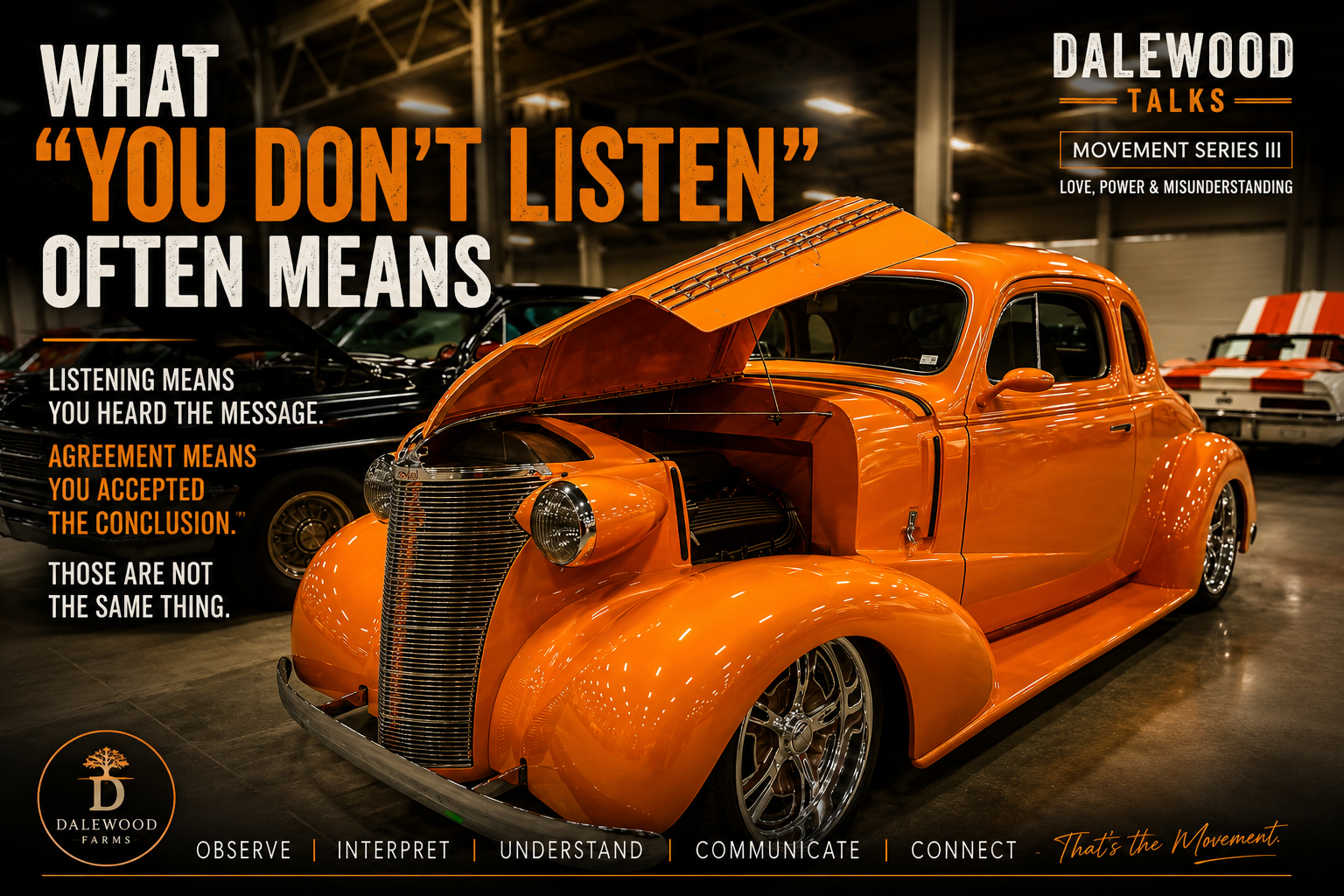
Listening means you heard the message.
Agreement means you accepted the conclusion.
Those are not the same thing.
The older I get, the more I realize communication is less about intelligence and more about discipline.
The discipline to:
- clarify before reacting
- ask before assuming
- interpret carefully
- separate intent from emotion
That’s hard to do.
Especially when the conversation touches identity, belief, fear, or pain.
But without that discipline, people stop solving problems.
They start defending themselves.
And once two people are defending themselves instead of pursuing understanding—
communication is already breaking down.
Strong relationships aren’t built on constant agreement.
They’re built on the ability to hear each other clearly without demanding identical conclusions.
That’s true in marriage.
Friendship.
Leadership.
Business.
Family.
And honestly, probably society as a whole right now.
Because people don’t just want to be heard anymore.
They want their interpretation accepted too.
And those are very different things.
Continue the Series
Ultimatums Are Fear in Armor
Boundaries Feel Like Abandonment
Movement Series III — Love, Power & Misunderstanding


Leave a Reply